The Vast and the Void: Why Ocean Isolation Has Become Cinema's Most Honest Portrait of Modern Loneliness
There is something philosophically precise about the way the open ocean frames human solitude on screen. It offers no distraction, no digital refuge, no ambient social noise to dull the edges of self-awareness — only the horizon, the hull, and whatever a person carries inside. As American audiences navigate an era defined simultaneously by hyperconnectivity and profound disconnection, maritime cinema has quietly emerged as the genre most capable of articulating what contemporary isolation actually feels like from the inside.
This is not a coincidence of genre fashion. It reflects something structurally true about what the ocean, as a cinematic environment, is capable of doing to narrative and character that no other setting can replicate with the same economy or force.
Designing the Conditions of Unavoidable Selfhood
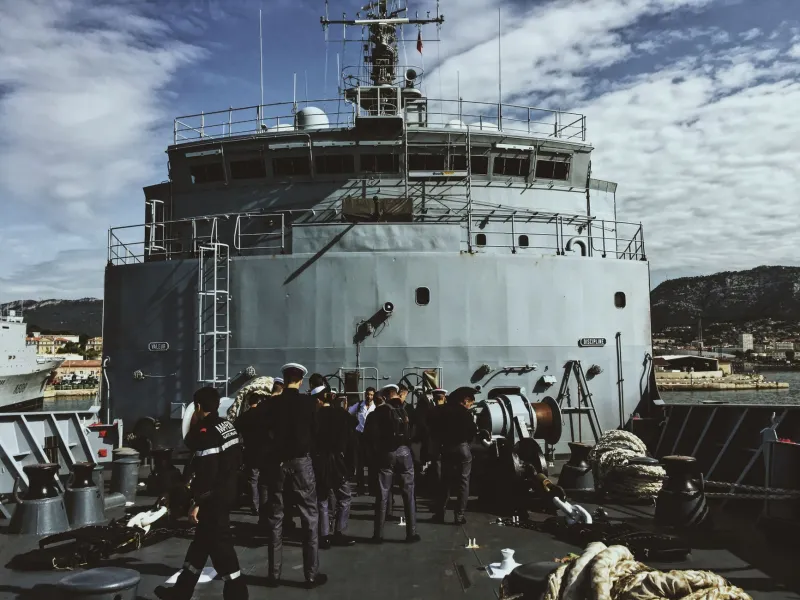
Production designers working on maritime films speak with remarkable consistency about the challenge of creating spaces that feel simultaneously confining and boundless. A ship at sea presents this paradox in its most concentrated form: the vessel itself is small, its social world compressed to the point of claustrophobia, yet the environment surrounding it is the largest and most indifferent on Earth. There is nowhere to go. There is also, in every meaningful sense, nowhere to hide.
This spatial logic is not merely a visual property of the setting. It is a psychological one, and the filmmakers who have most effectively deployed maritime isolation as an existential instrument understand that the real work happens in how the production design shapes the interior life of characters who can neither leave nor ignore themselves. Cabins are deliberately undersized. Common spaces are structured to make privacy impossible. The deck offers exposure rather than relief. Every architectural choice in a well-designed maritime production communicates the same fundamental condition: you are here, fully, and there is no alternative available.
For contemporary American audiences conditioned to manage discomfort through distraction — the phone, the feed, the infinite scroll — this condition reads as both alien and deeply familiar. It is the experience of being alone with one's own thoughts in a culture that has largely ceased to tolerate that experience. Maritime cinema stages it at an extreme that makes the underlying anxiety legible in a way that more realistic contemporary settings rarely achieve.
The Philosophical Architecture of the Horizon
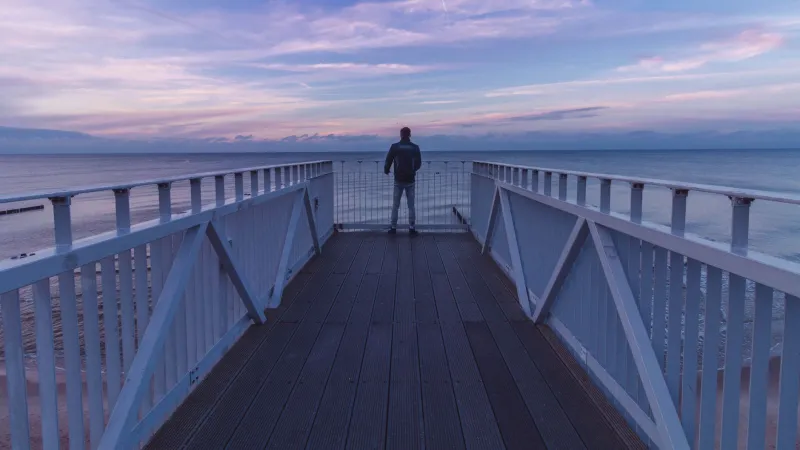
The horizon is, among the visual elements available to filmmakers, perhaps the most philosophically loaded. It represents the limit of perception, the boundary between the known and the unknowable, the point at which human vision — and by extension, human certainty — simply stops. In terrestrial settings, the horizon is usually interrupted by structures, topography, and the accumulated evidence of human presence. At sea, it is unobstructed, and its unobstructed quality communicates something that no amount of dialogue can say as efficiently: that the universe does not concern itself with the people looking at it.
Filmmakers who grasp this tend to use horizon shots not as establishing imagery but as punctuation — placing them at moments when a character's internal reckoning requires the visual confirmation of their own insignificance. The cut from a human face in crisis to the flat, featureless line where ocean meets sky is one of the most emotionally precise moves available in the grammar of maritime cinema, and its precision derives entirely from the philosophical weight the horizon carries independent of any narrative context.
This is one reason why maritime isolation functions so effectively as a vehicle for existential themes that might feel labored or over-articulated in other settings. The environment does the philosophical work without requiring the script to state it.
Solitude as Production Challenge
From a purely practical standpoint, conveying genuine isolation on screen is one of the more technically demanding tasks a maritime production faces. The presence of a camera crew, safety personnel, and production infrastructure means that the actor performing solitude is, in reality, surrounded by dozens of people. The challenge of creating authentic aloneness under these conditions has driven some of the most inventive production decisions in the genre's recent history.
Some directors have responded by minimizing crew presence during key shooting periods, working with skeleton teams and accepting the limitations that imposes on coverage and technical precision. Others have invested in production schedules that allow performers extended time on the water without cameras, accumulating a physical and psychological memory of genuine isolation that can then be drawn upon during staged sequences. The goal, in every case, is the same: to give the performer access to something real enough that the performance does not need to manufacture what the environment has already provided.
Sound design plays an equally critical role. The acoustic texture of genuine oceanic isolation — the particular quality of wind against steel, the absence of the ambient human noise that saturates every land-based environment — is something that cannot be fully replicated in post-production. Productions that record extensively on location, even at significant logistical cost, consistently produce work in which the sense of isolation registers as physical rather than merely visual.
The American Audience and the Fear of Being Alone
There is a reason maritime isolation resonates with particular force in the American cultural context. The United States is a society that has, for most of its modern history, treated solitude with suspicion — associating it with failure, eccentricity, or psychological instability rather than with the kind of productive interiority that many other cultural traditions value. The person who is alone is, in the dominant American social imagination, a person who has not succeeded at connection.
Ocean cinema disrupts this assumption by making solitude not a choice but a condition — imposed by circumstance, by geography, by the fundamental structure of the world. When a character at sea is alone, no social judgment attaches to that aloneness. It is simply the truth of their situation. And in that removal of social judgment, something opens up for the audience: the possibility of sitting with isolation, examining it, and recognizing in it something that the noise of ordinary life has not permitted them to acknowledge.
This is, ultimately, what the best maritime films offer that no other genre can quite replicate. Not escape from loneliness, but a space in which loneliness can be honestly examined — held up to the light of a vast and indifferent sea and recognized, without shame, as one of the fundamental conditions of being human.