The Horizon as Judge: How the Open Sea Dissolves the Moral Architecture That Keeps Villains in Check
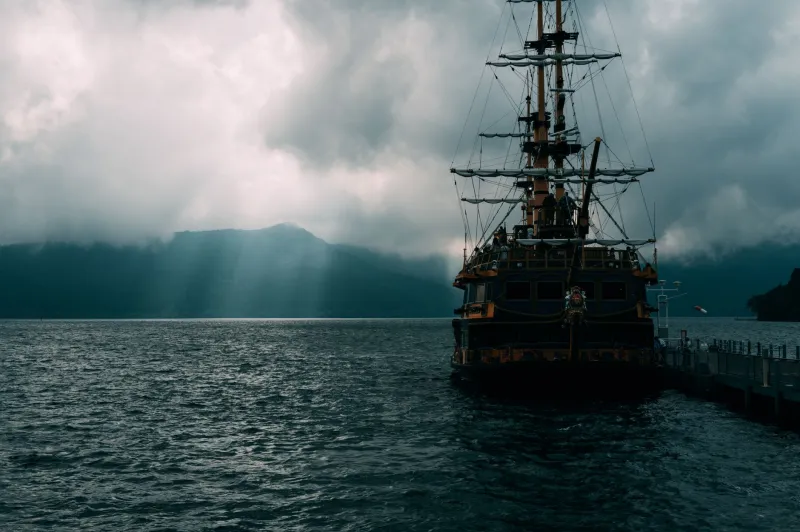
There is a moment in nearly every great maritime thriller when the audience registers the same cold realization the protagonist has already reached: no one is coming. Not the coast guard. Not a judge. Not even the abstract reassurance of a functioning society that punishes cruelty and rewards restraint. The ship has moved beyond the jurisdiction of all those invisible agreements that hold civilization together, and in their absence, something else takes over.
That something else is the subject of some of the most psychologically compelling storytelling in American cinema—and it is precisely what makes characters like Wolf Larsen so enduringly disturbing.
When Geography Becomes Moral Erosion
On land, villainy operates within a system of friction. A corrupt employer knows that an employee can quit and report him. A bully understands, however dimly, that witnesses exist and consequences may follow. Even the most ruthless figures in domestic or urban narratives must calculate the cost of their actions against an environment populated by institutions designed to resist them.
At sea, that friction disappears almost immediately.
Screenwriters working in the maritime genre have long recognized that this disappearance is not merely a plot convenience—it is the genre's central psychological engine. The ship doesn't just isolate characters physically. It strips away the scaffolding of accountability that most people never consciously notice until it's gone. What remains is a pressure vessel in which power concentrates rapidly and those who hold it face no external corrective force.
In Jack London's source material, Wolf Larsen articulates this condition with almost academic precision. He understands that his authority aboard the Ghost is absolute not because he has earned it through wisdom or legitimacy, but because the ocean itself enforces it. Distance from shore is, in his worldview, the purest form of sovereignty. The film adaptations of London's novel have wrestled repeatedly with how to dramatize this logic without making it seem like mere raving—because, troublingly, it isn't.
The Ship as Pressure Cooker
What distinguishes the maritime thriller from other confined-space narratives—the prison film, the bunker story, the locked-room mystery—is that the confinement is not incidental. It is the point.
A prison film still operates within a society that built the prison, staffs it, and theoretically governs it. Even in the most corrupt institutional narratives, there is an outside world pressing against the walls. But a ship at sea in the late nineteenth or early twentieth century, the period that dominates the genre's most influential entries, existed in a genuinely lawless space. The captain's word was the closest approximation of law available, and if that captain was a man like Larsen—brilliant, physically imposing, and philosophically committed to a worldview that denied any moral obligation to the weak—then the crew had no recourse whatsoever.
Filmmakers have exploited this condition with considerable sophistication. The ship does not simply reveal a villain's pre-existing nature; it actively amplifies and in some cases manufactures it. Characters who might have functioned as difficult but tolerable figures in a shore-bound context become something far darker when every grievance they hold against the world is suddenly, structurally validated by their environment.
The man who believes the strong deserve to dominate the weak finds, aboard a vessel three hundred miles from the nearest port, that reality appears to confirm his philosophy at every turn. This is the pressure cooker effect: not heat applied from outside, but pressure building from within, with no release valve and no external intervention.
Circular Reasoning, Circular Hunting
There is something geometrically appropriate about the way maritime villains tend to justify their escalating brutality. Their logic moves in circles, and so does their domain.
A ship at sea traces routes, but it also, in a psychological sense, hunts in circles. The crew cannot leave. The villain cannot truly escape the consequences of his own character, even as he escapes legal consequence. And the justifications he constructs for each new cruelty feed back into the next one, each act of violence requiring a slightly more elaborate philosophical framework to absorb.
Wolf Larsen's famous monologues about the meaninglessness of individual human life are not random cruelty dressed in intellectual clothing—they are the product of a man who has spent years in an environment that appeared, to him, to validate every cynical premise he arrived with. The ocean is indifferent to suffering. The strong fish consume the weak. Men die at sea without ceremony or record. If you are already inclined toward a philosophy that denies the intrinsic value of human life, the open ocean is the most persuasive argument available.
Screenwriters dramatizing this dynamic face a genuine craft challenge: how do you render this logic coherent enough to be frightening without endorsing it? The best maritime films walk this line carefully, allowing the villain's worldview to feel internally consistent while ensuring the audience understands what it costs the people subjected to it.
What Traditional Law Enforcement Cannot Reach
American audiences carry a particular cultural relationship to law enforcement and justice that makes the maritime villain's situation resonate in specific ways. The United States is a nation built substantially on the idea that legal recourse is available—that the aggrieved can appeal to institutions, that power can be checked, that no individual's authority is truly absolute.
The maritime setting systematically dismantles every one of these assumptions.
The sheriff's office is not coming. The labor board has no jurisdiction here. The concept of due process is as remote as the coastline. For an American audience conditioned to believe in the reachability of justice, this removal is viscerally disturbing in ways that a dungeon or a foreign prison might not be—because it is not the result of extraordinary circumstances. It is simply the result of distance.
This is what gives films like adaptations of The Sea Wolf their lasting grip on the imagination. They do not require a fantastical premise or a supernatural antagonist. They require only a ship, an ocean, and a man who understands exactly what that combination means.
The Manufacture of Monstrosity
Perhaps the most unsettling implication of the maritime thriller's psychological architecture is this: the villain is not entirely wrong about his environment.
The ocean is, in fact, indifferent. Power does, in fact, concentrate aboard a vessel in ways it cannot on land. Accountability does, in fact, become geographically impossible beyond a certain distance from shore. The maritime villain's error is not in his reading of the environment—it is in his conclusion that this environmental reality constitutes a moral permission.
That distinction is the entire drama. And it is why the ship, as a cinematic space, continues to generate stories of such psychological density. It is not merely a setting. It is a laboratory for examining what human beings become when the structures that normally mediate between power and conscience are removed—not by catastrophe, not by conspiracy, but simply by the accumulation of nautical miles between the hull and the nearest courthouse.
For a project like The Sea Wolf, these questions are not historical curiosities. They are the living center of the story. Wolf Larsen's world is one in which justice has been replaced by the horizon, and the horizon, as every sailor knows, only appears to be reachable. The closer you get, the further it moves.