Wolf Larsen's Shadow: How a 19th-Century Literary Monster Shaped Hollywood's Most Compelling Antiheroes

When Jack London published The Sea Wolf in 1904, he could not have anticipated that his philosophical sea captain would become one of the most enduring character archetypes in American storytelling. Wolf Larsen — captain of the sealing schooner Ghost, self-taught intellectual, and remorseless tyrant — was unlike anything readers had encountered. He was not a simple villain. He was something far more unsettling: a man of genuine brilliance who had arrived at a worldview stripped of compassion, mercy, or sentiment. More than a century later, his shadow stretches across the history of cinema in ways both obvious and quietly profound.
The Anatomy of a Philosophical Predator
To appreciate Larsen's cinematic legacy, one must first understand what made him so radical a creation in his own time. London constructed a character who operated entirely outside conventional moral frameworks — not out of ignorance, but out of a deliberate, almost scholarly rejection of them. Larsen devoured philosophy, debated Nietzsche and Spencer with his captive intellectual Humphrey Van Weyden, and articulated a doctrine of raw, biological power that was as coherent as it was terrifying.
This combination — formidable intelligence wed to absolute ruthlessness — was the blueprint. Prior to Larsen, literary antagonists tended toward either cartoonish malevolence or tragic, redemption-seeking darkness. Larsen offered a third path: the antagonist who is not wrong in his logic, only monstrous in his conclusions. This is precisely the quality that would come to define the most memorable screen villains of the twentieth and twenty-first centuries.
Hollywood's earliest adaptations of the novel — most notably the 1941 Warner Bros. production starring Edward G. Robinson — demonstrated just how cinematic Larsen's nature was. Robinson's portrayal captured the character's volcanic intelligence and physical menace, but more importantly, it established for American audiences the idea that a villain could command genuine admiration while remaining irredeemable. The film was a commercial and critical success, suggesting that audiences were hungry for moral complexity in ways that the industry had not yet fully recognized.
The Larsen Lineage: From Golden Age to New Hollywood
The decades that followed the Robinson adaptation saw Hollywood cautiously expanding the boundaries of what an antagonist could be. The Production Code era constrained overt moral ambiguity, but even within those restrictions, the Larsen archetype persisted. Characters who wielded power with philosophical justification, who were educated and articulate in their cruelty, began appearing with increasing frequency.
By the time New Hollywood emerged in the late 1960s and 1970s, the Larsen template had been quietly absorbed into the industry's storytelling vocabulary. Francis Ford Coppola's Colonel Kurtz in Apocalypse Now — a military commander who has followed his own logic to its ultimate, horrifying conclusion in the jungles of Southeast Asia — is perhaps the most direct cinematic descendant of Wolf Larsen that American film has produced. Like Larsen, Kurtz is no mere sadist. He is a man who has thought deeply, concluded ruthlessly, and built an empire of terror on the wreckage of conventional morality. Marlon Brando's performance, with its quiet, intellectual menace, echoes Robinson's Larsen in ways that feel more than coincidental.
The 1980s and 1990s saw the antihero concept move from the margins to the mainstream. Characters such as Hannibal Lecter in The Silence of the Lambs — brilliant, cultured, and utterly without remorse — bear unmistakable traces of the Larsen archetype. Lecter's combination of refined intellect and predatory instinct is Larsen transposed from the Pacific to a federal prison cell. Both characters use philosophical discourse as a weapon, and both compel audiences to engage with their worldview even as they recoil from their actions.
The Modern Antihero and the Larsen Standard
Contemporary cinema has arguably taken the Larsen blueprint further than London himself imagined possible. The golden age of prestige television — which has increasingly blurred the line between film and serialized storytelling — has produced a generation of protagonists who embody Larsonian qualities in their entirety. Walter White of Breaking Bad, Tony Soprano, and Frank Underwood of House of Cards all operate according to personal philosophies that are internally consistent and externally catastrophic. Each man believes, with genuine conviction, that his ruthlessness is justified. Each man is capable of expressing that conviction with intelligence and even eloquence.
In the realm of theatrical film, the Marvel Cinematic Universe's Thanos — a villain whose genocidal ambitions are rooted in a coherent, if grotesque, ecological philosophy — represents the Larsen archetype scaled to cosmic proportions. The character's creators have openly acknowledged that a villain must believe he is right; Larsen demonstrated this principle more than a century before the MCU made it a franchise cornerstone.
More recently, films such as No Country for Old Men and its antagonist Anton Chigurh have revisited the philosophical predator concept with remarkable fidelity to the Larsen model. Chigurh's articulation of fate and chance as justifications for violence is, structurally, identical to Larsen's Social Darwinist arguments. Both characters use ideas as instruments of domination.
Why the Archetype Endures
The persistence of the Wolf Larsen archetype in American cinema is not accidental. It speaks to a deep cultural ambivalence about power, intelligence, and morality that London tapped into at the dawn of the twentieth century and that has only grown more complex in the decades since. Americans have always been fascinated by individuals who operate outside conventional constraints — the outlaw, the maverick, the self-made man taken to his most extreme logical conclusion.
Larsen embodies all of these figures simultaneously. He is the self-made man who has read too much and felt too little. He is the captain who has confused authority with sovereignty. He is the intellectual who has mistaken cleverness for wisdom. These are not merely literary qualities; they are recognizable human failure modes, rendered at their most dramatic and dangerous.
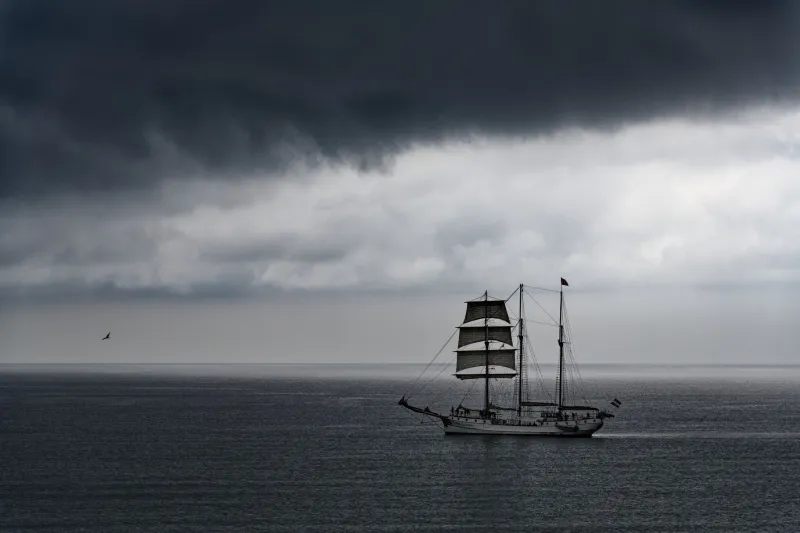
For filmmakers working in the maritime genre specifically, Larsen's legacy is inescapable. The ocean, as London understood and as any serious nautical production must acknowledge, is the ultimate environment for the examination of power and its abuses. Removed from civilization's moderating influence, stripped of legal recourse and social accountability, characters at sea reveal themselves with a clarity that landlocked settings cannot replicate.
As new adaptations and maritime productions continue to emerge — including contemporary projects that return directly to London's source material — the question is not whether Wolf Larsen's influence will be felt, but how consciously filmmakers will engage with it. The archetype he established remains as vital and as dangerous as the ocean itself: a force that rewards those who understand it and punishes those who do not.