When the Tide Comes In: The Recurring Appetite for Maritime Disaster Films in an Age of Collective Anxiety
There is a particular kind of story that Americans reach for when the ground beneath them feels unstable. It is not, perhaps surprisingly, a story of safety or reassurance. It is a story of people in far worse situations than their own—battered by forces incomparably larger than any personal hardship, stripped of every comfort, and required to answer a single question with their bodies and their choices: will you survive this?
Maritime disaster cinema has provided that story, in various forms, for as long as film has existed. And its popularity, examined carefully, traces a map of American anxiety with remarkable precision.
A Genre That Breathes With the Nation
The relationship between cultural stress and disaster film consumption is not a new observation in academic circles, but maritime cinema presents a particularly clean case study. The genre's peaks align with identifiable moments of national unease in ways that exceed coincidence.
The post-World War II era produced a wave of sea-survival narratives as American society processed collective trauma and the disorientation of sudden peace. The 1970s, defined by economic stagflation, Watergate's institutional collapse, and the hangover of Vietnam, gave rise to a cycle of disaster films—ocean-set among them—that reflected a population no longer confident in the systems designed to protect it. The early 2000s and the period following the 2008 financial crisis each brought renewed interest in stories of ordinary people confronting extraordinary peril with minimal institutional support.
The pattern is consistent enough to suggest something structural. When Americans feel that familiar anchors—economic security, institutional trust, social cohesion—are loosening, they turn toward narratives that dramatize the loosening in its most extreme form, then watch to see what survives it.
The Psychology of Controlled Terror
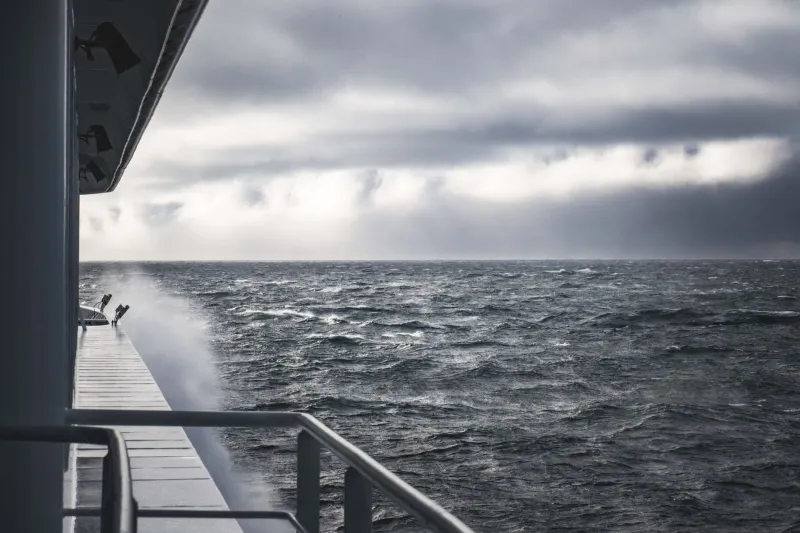
To understand why this dynamic operates, it helps to consider what the maritime disaster film offers that other genres do not. The ocean is singular as a cinematic environment because it is genuinely, non-metaphorically dangerous. Unlike the haunted house or the monster-stalked forest, the sea requires no suspension of disbelief. Its capacity to kill is not a genre convention—it is a geological fact.
This authenticity matters enormously to audiences in distress. When a viewer's real-world anxieties feel vague, systemic, and resistant to individual action—when the threat is a recession, a social fracture, or a creeping sense that institutions cannot be trusted—the ocean provides a clarifying alternative. The danger is visible. The stakes are immediate. The required response is physical and comprehensible.
Psychologists who study entertainment consumption have noted that exposure to fictional extremity can function as a form of emotional rehearsal. Watching characters navigate catastrophe does not merely distract from personal anxiety; it provides a template, however stylized, for thinking about resilience, prioritization, and the irreducible core of what matters when everything else is stripped away.
Men Against Nature, Audiences Against Drift
Maritime disaster narratives almost universally center on the conflict between human will and natural force, and this framing carries specific cultural weight in the American context. The tradition of the self-reliant individual confronting an indifferent wilderness runs deep in the national mythology, from the frontier narratives of the 19th century forward.
The ocean updates that mythology for audiences who no longer have a frontier. It provides a space where individual agency is tested against something genuinely larger than society, where credentials and social position are irrelevant, and where survival depends on qualities—endurance, ingenuity, solidarity—that cannot be purchased or delegated.
In periods when Americans feel that their personal agency has been diminished by forces they cannot name or confront—economic systems, political dysfunction, technological acceleration—the maritime disaster film offers a fantasy of legible stakes. Here is your enemy. Here is your body. What will you do?
The Social Dimension: Survival as Community
It would be a misreading to characterize the genre as purely individualistic. The most resonant maritime disaster narratives are not stories of solitary heroism but of fractured groups learning, under duress, to function as something resembling a community. The ship's crew, thrown together by circumstance and stripped of their usual social identities, must negotiate trust, sacrifice, and collective purpose under conditions that make those negotiations impossible to defer.
This social dimension speaks directly to another persistent American anxiety: the fear that the social fabric is thinning, that common purpose is eroding, that the capacity for collective action is diminishing. Maritime disaster cinema tests that fear in a controlled environment and, more often than not, offers a cautiously affirmative answer. People, the genre tends to conclude, can still cohere when it matters enough.
That conclusion is not naïve—the best films in the tradition earn it through genuine sacrifice and loss—but it is hopeful in a way that feels earned rather than manufactured.
What the Current Moment Suggests
American audiences in the present moment arrive at maritime cinema carrying a particular cargo of accumulated uncertainty. The past several years have delivered economic disruption, deepening political division, a pandemic that made the concept of uncontrollable systemic risk viscerally personal, and a pervasive sense that institutions are operating at reduced effectiveness.
The conditions, in short, are precisely those that have historically driven audiences toward survival narratives set at sea. The ocean asks nothing of a viewer's political identity or economic position. It does not care about the news cycle. It simply presents the oldest question in the human repertoire: how much can you endure, and who will you be while you endure it?
For audiences who feel adrift in ways they struggle to articulate, that question—asked through the grammar of crashing waves and straining hulls—offers something that more contemporary genres rarely provide: the clarity of an honest reckoning.